

One of Luke’s shortest portraits is also one of his most active. Anna comes forward, thanks God and speaks about the child. These ten original AI-assisted compositions explore that movement from years of prayer to the moment of recognition. Look for Anna’s hands and gaze, and for what each image gives her to do.
Read the historical art guide →
In this guide
- Anna Speaks of the Child
- Anna Gives Thanks before the Child
- Anna's Prayer in the Temple Light
- The Elder Witness before the Holy Family
- The Child Raised toward Anna
- The Open Hands before Jesus
- The Quiet Greeting in the Colonnade
- The Recognition beside Mary's Veil
- Hands Folded beside the Sleeping Child
- Anna Bows before the Infant
Who is Anna in Luke’s Gospel?
Luke 2:36–38 identifies Anna as a prophetess, the daughter of Phanuel, from the tribe of Asher. He describes her as an elderly widow who worshipped with fasting and prayer. She thanks God and speaks about Jesus to people awaiting the redemption of Jerusalem. Simeon holds the child and gives the canticle earlier in the chapter. Anna’s work in the story is public testimony.
1. Anna Speaks of the Child

This composition puts speech at the centre. Follow Anna’s attention as it moves outward from the child. Luke says that she spoke to those awaiting Jerusalem’s redemption, so the painting offers a natural way into that final verse.
2. Anna Gives Thanks before the Child

Thanksgiving supplies the second half of Anna’s story. Her presence near the infant makes the subject one of recognition as much as worship. Compare the scene with Anna Speaks of the Child to see how a single figure can carry both themes.
3. Anna's Prayer in the Temple Light

Prayer bridges the years before the encounter and the moment of recognition. The Temple setting makes that continuity visible. In the biblical account, Anna is already at home in this place of worship.
4. The Elder Witness before the Holy Family

The difference in age gives the scene its visual force. Look from the prophetess to the infant and back again. The small physical distance contains the long wait that the Gospel gives to Anna in a few sentences.
5. The Child Raised toward Anna

The gesture of lifting the child changes where the viewer looks. It brings the meeting to eye level and gives Anna room to respond. Read it as the artist’s interpretation of the encounter.
6. The Open Hands before Jesus
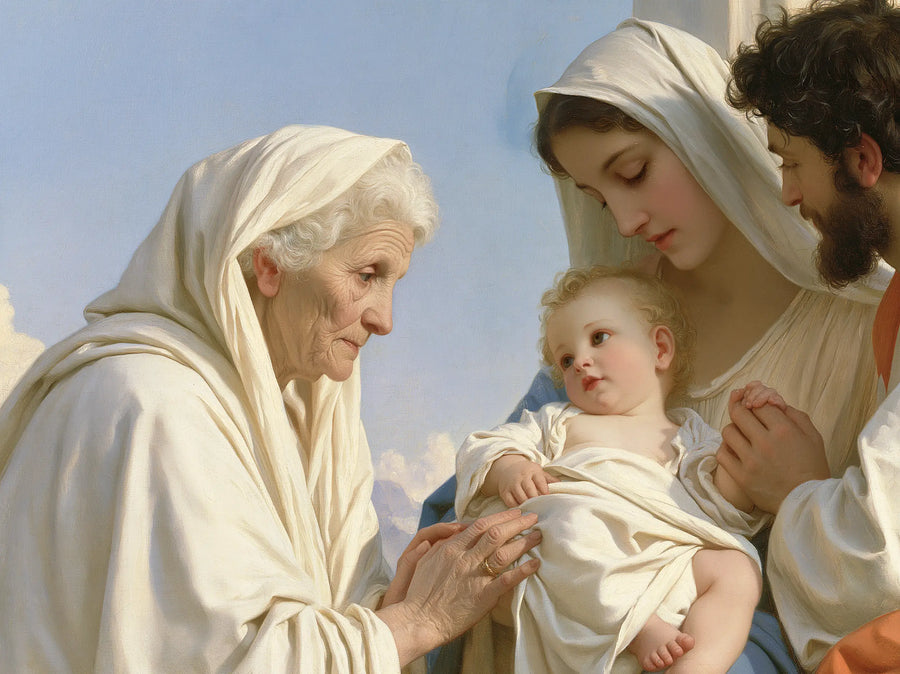
Open hands are a simple way to show a response without putting words on the canvas. Compare their position with the stillness of Hands Folded beside the Sleeping Child. The two gestures can suggest the public and private sides of prayer.
7. The Quiet Greeting in the Colonnade

The colonnade gives the encounter a place between enclosed worship and an outward-facing public space. It also provides a rhythm at the edges of the composition that can be read even from across a room.
8. The Recognition beside Mary's Veil

The veil is a useful point of orientation. It helps distinguish Mary from the older witness and brings the two women into a single field of attention. A painting of Anna can foreground her without losing Mary’s role in bringing the child.
9. Hands Folded beside the Sleeping Child

The sleeping infant gives the adults’ gestures added weight. Their quiet attention makes recognition intelligible even without the open hand of a speaker. Look for the transitions between the faces, hands and fabrics.
10. Anna Bows before the Infant
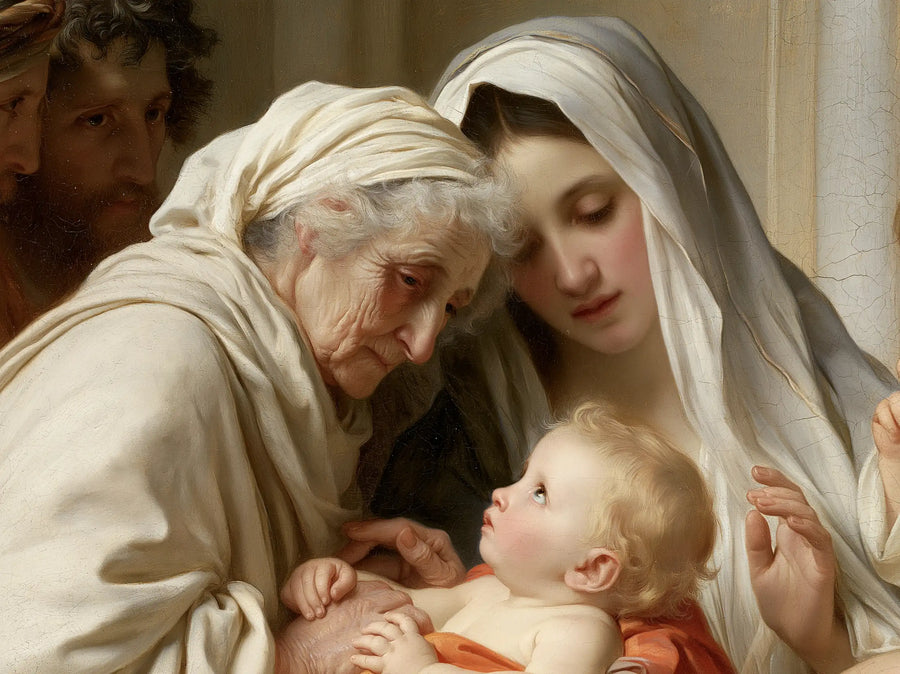
The lowered posture gives this version a quieter tone. Place it beside a print in which Anna speaks to see how an artist can choose one moment of the Gospel account and make it stand for the whole encounter.
Choose an image that reflects how you read the scene
For a print that tells the story clearly, start with Anna Speaks of the Child. For a quieter display, choose the bowed or folded-hands composition. If the work will hang across the room, check that Anna’s figure stays clearly distinct from the other people and the architecture.