

The Stations of the Cross invite viewers to pause at moments along the road to Calvary. These ten AI-created works from Alpha Christian Art focus on the procession, the falls, Veronica’s gesture of care and the women of Jerusalem.
Luke 23:26–31 describes Simon of Cyrene and Jesus’s encounter with the women. The falls and Veronica belong to the traditional devotional sequence. The images give each kind of episode a place along the road.
1. Sacred Monumental View No. 2

The wide composition introduces the road to Calvary as a shared space. Follow the main group from a distance, then look for the figures nearest Jesus. A wide print lets the landscape and the procession stay visible together.
2. Jesus Falls under the Cross No. 8

This work places the fall within an extended landscape. Notice how the outline of the cross relates to the horizon and how the central figure interrupts the larger group’s movement.
3. Jesus Falls under the Cross No. 1

Study the fall in this alternative treatment. Give the space immediately around Jesus time to register. It changes how much of the picture reads as a procession and how much reads as a moment of exhaustion.
4. Jesus Falls under the Cross No. 7

Compare this version with the two preceding landscapes. Start with the shape formed by the body and cross. The location of that shape within the frame affects where the viewer sees a pause in the journey.
5. Veronica Tends the Face of Jesus

Veronica’s gesture gives the story a moment of closeness. Look first at the cloth between the two faces and then at the people behind them. The surrounding procession helps show how brief the encounter is.
6. The Compassionate Hand upon His Face
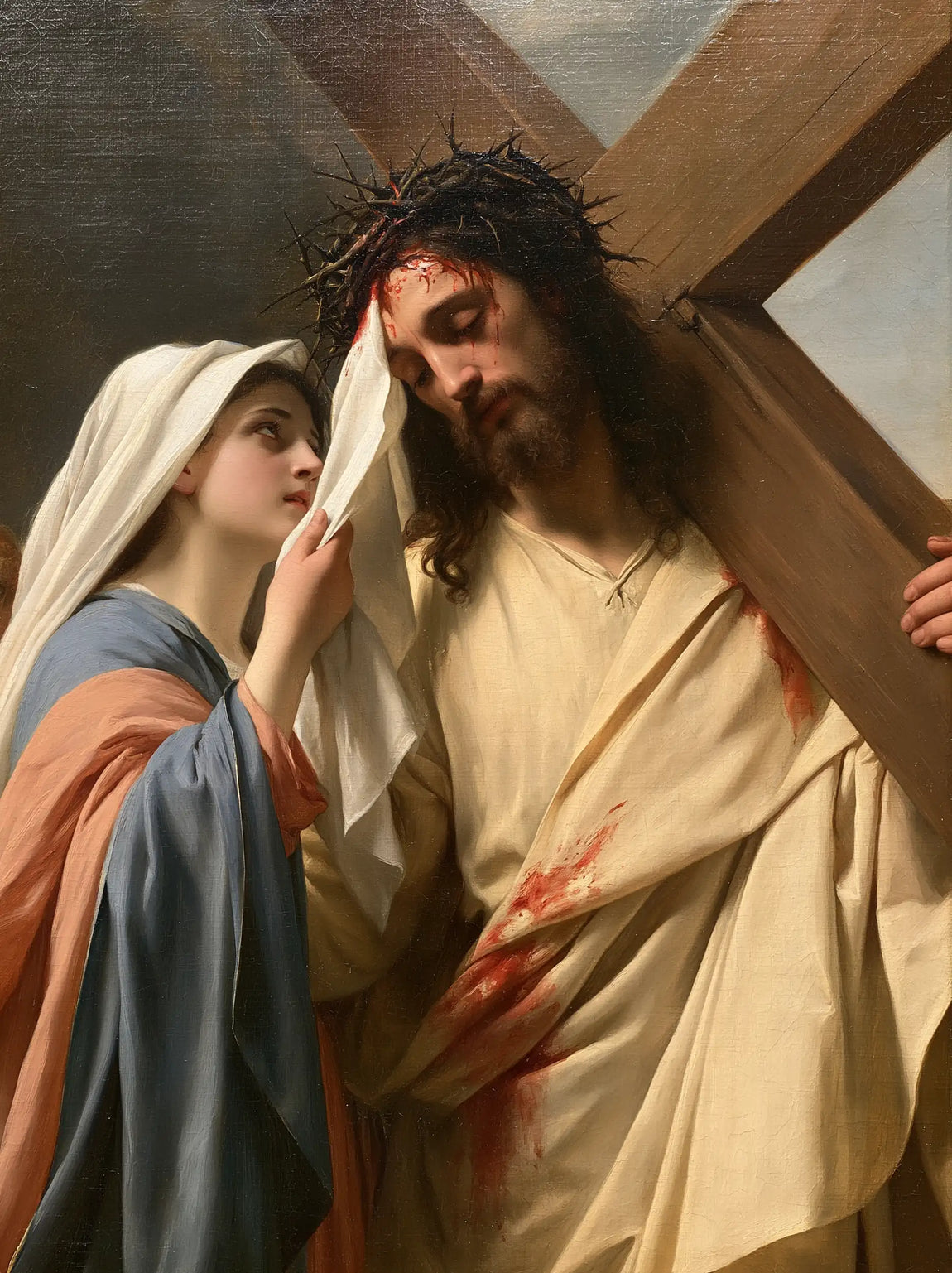
The portrait format concentrates on the hand and face. At a smaller size, the close arrangement can help the viewer read the expression without needing to resolve the whole procession.
7. The Veil Lifted beneath the Cross

The veil and the cross give this scene two strong shapes. Notice how one belongs to the action of helping and the other to the journey that continues around the figures. The wider view gives space to both.
8. The Women of Jerusalem Landscape No. 9

Read the group of women as a gathered audience. Follow their positions relative to Jesus and to the route through the scene. The encounter is told through the distribution of figures as well as their expressions.
9. The Women of Jerusalem Landscape No. 11

Use this view to compare how the crowd frames the exchange. A wider print can help preserve the relation between figures that meet Jesus and those who remain further away.
10. The Women of Jerusalem Portrait No. 8

The upright view gives the encounter a more concentrated scale. For a narrow wall or prayer corner, consider this format where the relationship between the central faces can be read from up close.
Choosing a print for Lent and prayer
Start with a scene you would want to return to. A close view of Veronica gives attention to a small act of care. A scene of the women can invite you to look at how people gather around Jesus. A broad view of the road is easiest to read at a size that leaves room for the scenery and the figures.
Why does the same scene appear in several prints?
Each interpretation changes the figures’ scale, the atmosphere or the way the eye reaches the central gesture. Comparing several images lets you choose which part of the episode you want the print to emphasize.