

Our Lady of Fátima is often pictured in a white mantle with a rosary. These ten AI-created artworks interpret that devotional image in open landscapes and closer portraits. In some, the light and trees help tell the story. In others, attention rests on the hands, veil and beads.
The devotion recalls the apparitions reported by Lúcia dos Santos, Francisco Marto and Jacinta Marto in Portugal in 1917. The Sanctuary of Fátima identifies Cova da Iria as the setting of five of the six Marian apparitions. The white mantle and rosary offer a way into the story even when an artwork shows Mary alone.
1. The Halo Beneath the Colourful Boughs
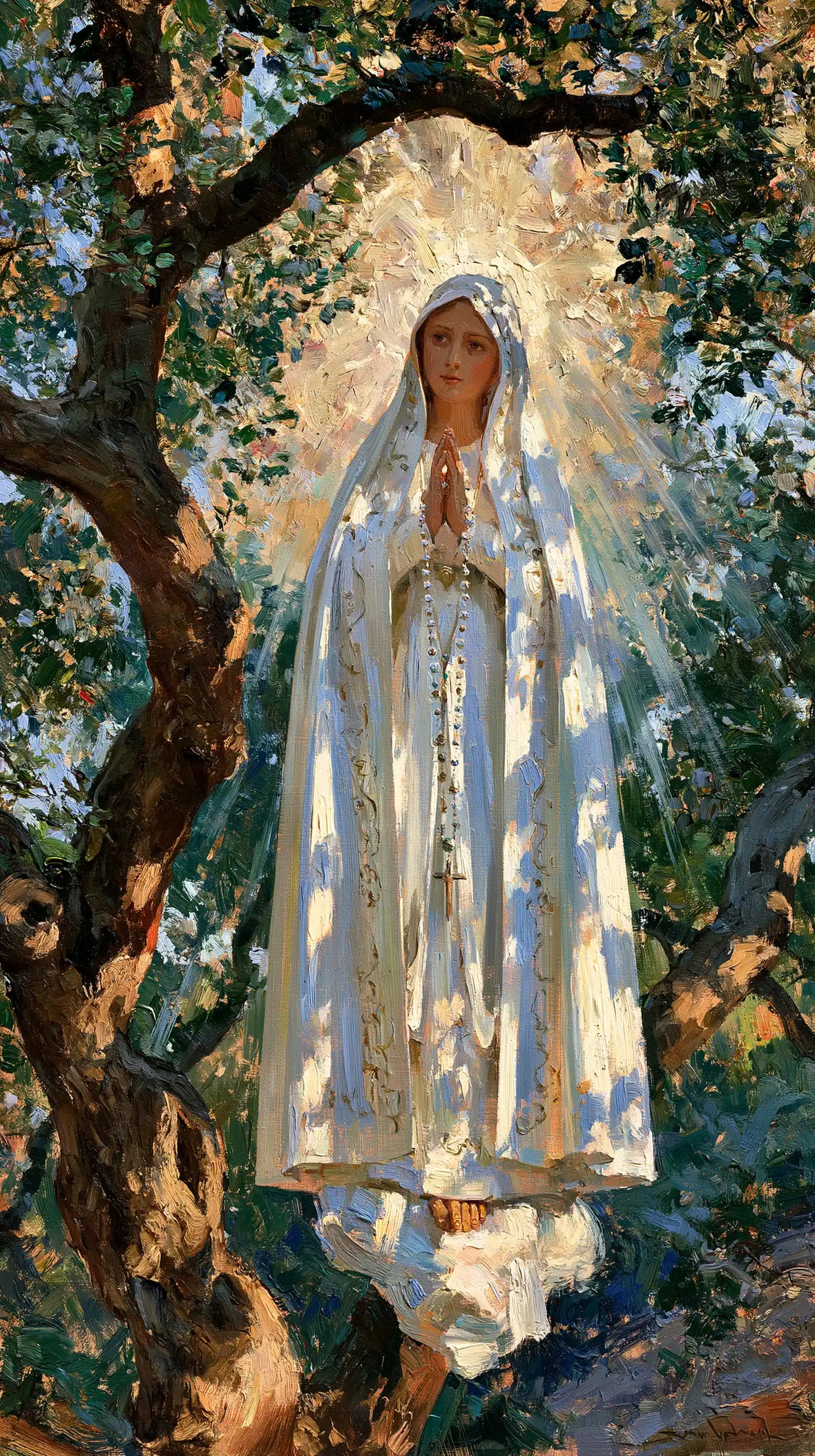
The boughs give the vision a landscape and a sense of scale. Compare the shape of the foliage with the outline of Mary’s mantle. This is a good choice if you want the setting to carry part of the story.
2. White Mantle on Warm Gold

A warm gold field places the white mantle in sharp relief. Look at the edge of the veil and how it leads toward the hands. The limited palette keeps those details visible in a small print.
3. Rosary in the Cloudlit Meadow

The title draws your attention to the rosary within an outdoor setting. Find the beads first, then follow the light into the landscape. Both details are easier to read when the whole composition retains its original proportions.
4. The Dappled Veil of Recollection

Dappled light gives the veil a softer edge. Look for where the folds catch the light before you study the face. The result has a more intimate scale than the broad meadow scenes.
5. The White Medallion Above the Veil

The white shape above the veil echoes the light of the garment. Compare that placement with an outdoor scene, where the same role might be played by the open sky. Leave enough headroom in the display for the upper detail.
6. White Mantle Above the Olive Grove

The olive grove frames Mary’s figure and gives the design a sense of place. It is an artistic interpretation of the Portuguese countryside. The Fátima sanctuary identifies a holm oak at the site of the apparitions.
7. Full-Length Figure in Sacred Blue

The full-length figure sets a vertical rhythm through the mantle. The blue around it helps separate the pale fabric from the background. A tall space allows the figure to remain visible from head to foot.
8. The Ivory Train Under the Dark Canopy

The darker canopy makes the train of the white mantle easy to trace. Look at the transition from bright fabric to the surrounding foliage. Diffuse light helps the darkest areas remain readable in a reproduction.
9. Rosary Beneath a Clear Blue Sky

The open blue sky sets off the white veil and draws attention to the gesture of prayer. Look at the rosary after taking in the figure as a whole. A matte finish can keep the small beads legible in daylight.
10. Rosary and Bowed Head

This version emphasizes the lowered head and the rosary. A smaller format can work at close range, especially in a quiet reading or prayer space. Choose a size that keeps the hands and beads distinct.
How do the mantle, beads and trees help identify the subject?
The pale mantle gives the figure a distinct outline, while the beads connect the image with the Rosary. In landscape versions, a low tree can recall the Cova da Iria setting. Background color, flowers and light can vary as artists imagine the scene.
Choosing a Fátima art print
A close view can suit a reading or prayer corner where the hands and beads are seen at short range. A full-length figure needs vertical space around the mantle. When foliage or sky frames the apparition, keep the edges visible so the setting remains part of the scene.