

A quiet gaze in a red field, a face emerging from darkness or a purple robe surrounded by guards can each mark the same episode of the Passion. These ten contemporary works were created with AI. They show how the choice of color, distance and gesture changes the way an image of Christ crowned with thorns is experienced.
What does the crown of thorns mean?
The crown belongs to the soldiers’ mockery of Jesus in the Passion. The robe and reed also suggest royal emblems, given in derision in Matthew 27:27–31. A portrait can leave the soldiers outside the frame and invite contemplation of Christ’s expression. A narrative scene makes their actions and the contrast with his bearing visible.
Explore the ten works
- The Quiet Gaze upon the Scarlet Field
- The Prayer beneath Tangled Thorns
- The Seated Christ beneath the Spears
- The Mocked Christ between the Soldiers
- The Upward Gaze beneath Black Thorns
- The Crowned Christ beneath the Blue Vault
- The Tear on the Cheek in Ivory Light
- The Silent Face against the Night
- The Reed and Purple Robe in Dark Blue
- The Profile Turned toward the Light
1. The Quiet Gaze upon the Scarlet Field

The direct gaze stays legible against the red field. The broad area of scarlet sets the emotional tone and makes the fine branches of the crown more noticeable. A plain mat or frame gives the color room.
Choose your print format →2. The Prayer beneath Tangled Thorns
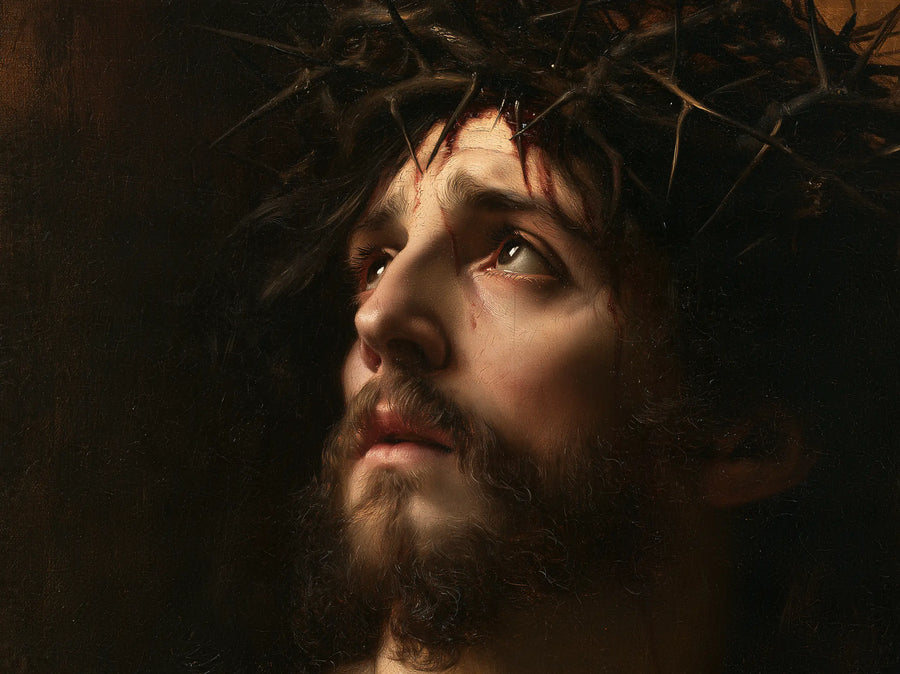
The woven branches frame the prayer. Follow their contour, then look at the expression beneath them. This compact composition works well where a print will be seen at close range.
Choose your print format →3. The Seated Christ beneath the Spears

The seated figure gives the standing guards and their weapons a strong vertical counterpoint. Notice how much the meaning depends on the space around Christ. Keeping that space visible preserves the tension of the scene.
Choose your print format →4. The Mocked Christ between the Soldiers

The nearby soldiers make this a moment acted out by a group. Compare how the gestures around Christ lead the eye to him. A larger print gives each of those gestures enough room to be read.
Choose your print format →5. The Upward Gaze beneath Black Thorns

The upward turn of the face guides the eye from the dark crown to the area of light beyond it. That small movement gives the portrait a sense of prayer without requiring a wider view of the scene.
Choose your print format →6. The Crowned Christ beneath the Blue Vault
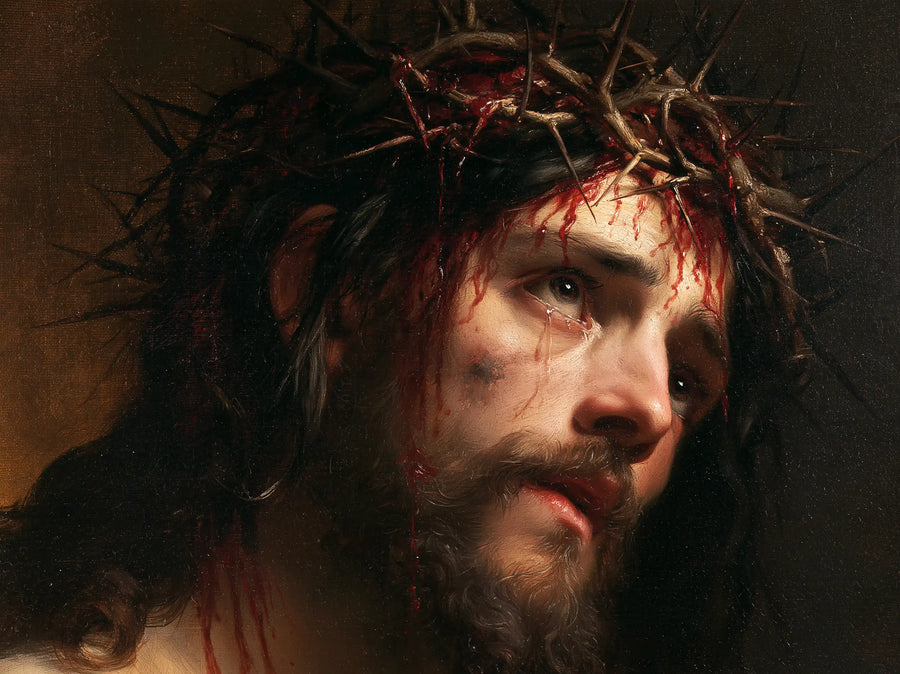
The blue overhead field changes the atmosphere. Notice the intervals of cooler color around the head. In a brightly lit room those quieter transitions can still hold the eye.
Choose your print format →7. The Tear on the Cheek in Ivory Light

The tear gives the viewer a detail to discover at close range. Ivory light makes the contours of the cheek and eyes easier to read. A matte fine art paper is a good choice for gradual changes in tone.
Choose your print format →8. The Silent Face against the Night

This portrait relies on small differences within a dark field. Look for where the face emerges first and how much of the crown remains visible. View it where soft light reaches the print.
Choose your print format →9. The Reed and Purple Robe in Dark Blue

The reed and robe make the mock coronation legible even in a sparse composition. Look at how each object suggests an emblem of kingship, then notice the way the blue background separates them from the surrounding space.
Choose your print format →10. The Profile Turned toward the Light
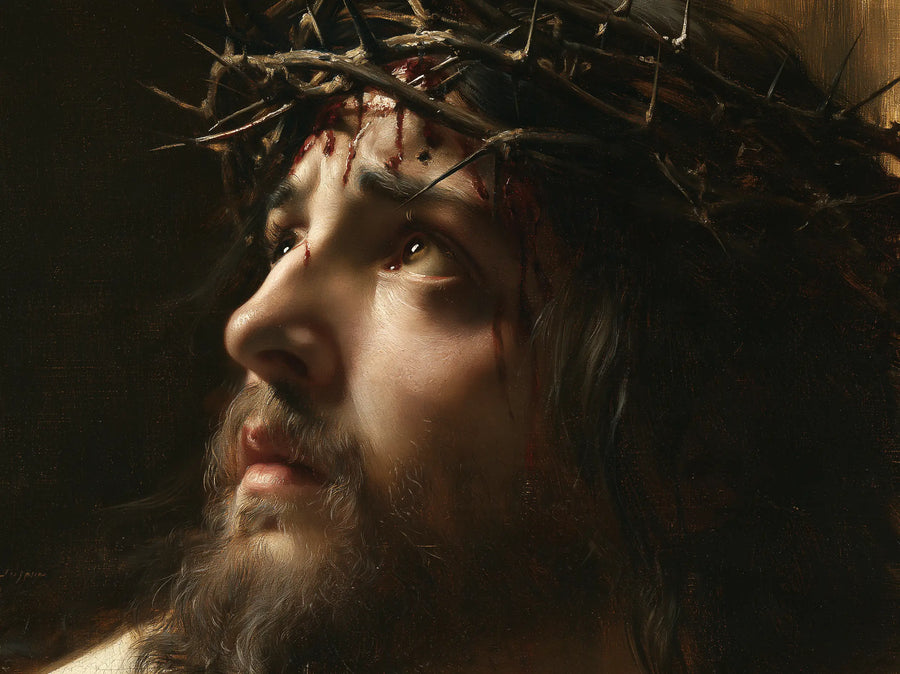
A profile lets the direction of the light tell much of the story. Follow the edge of the face from the brow to the chin. This makes a quiet alternative to the more confrontational direct gaze of the first print.
Choose your print format →How to choose a Crown of Thorns print
Start with where the print will be seen. A cropped portrait with a clear outline works at close range, while a scene with soldiers benefits from a larger format. In an alcove or prayer corner, choose a wall with enough light to distinguish dark blues and shadows. A strong red image can carry a wider wall with a simple frame.