

A wooden beam, a city gate and the slope toward Calvary give artists three ways to make the journey visible. These ten original AI-generated works from Alpha Christian Art show Jesus receiving the cross, carrying it through Jerusalem and continuing toward Golgotha. Each entry highlights a detail you can see in the image.
In this guide
- The Cross Placed upon His Shoulder
- The Crimson Sky and the Burdened Shoulder
- The Cross Carried through the City Gate
- The Long Road through Jerusalem
- The Cross through the Gathering Crowd
- The Prayerful Gaze beneath the Timber
- The Road to Golgotha in Golden Light
- The Procession through the Narrow Street
- The Quiet Gaze beneath the Dark Beam
- The Solitary Ascent beneath the Cross
The Gospel accounts of the road to Calvary
John 19:16–17 describes Jesus going out carrying the cross toward Golgotha, the Place of the Skull. Luke 23:26–31 introduces Simon of Cyrene carrying it behind Jesus and describes women mourning along the way. These details help explain why some images place Christ alone and others include Simon or a crowd. The Stations of the Cross also contain episodes, such as Veronica wiping Christ’s face, drawn from devotional tradition.
1. The Cross Placed upon His Shoulder

Begin with the point where the wood meets the shoulder. The subject is the moment of receiving the cross, so that contact carries the action. Look for a format that lets you see the posture clearly from where you usually sit.
2. The Crimson Sky and the Burdened Shoulder

Crimson gives the background a strong presence while the diagonal of the cross keeps the composition moving. Compare it with the golden road below. The two palettes give very different moods to a similar theme.
3. The Cross Carried through the City Gate

The gate makes a visible threshold. Follow the figure through the opening and notice how the architecture sets the route. An image like this tells a recognizable story even when viewed from several steps away.
4. The Long Road through Jerusalem
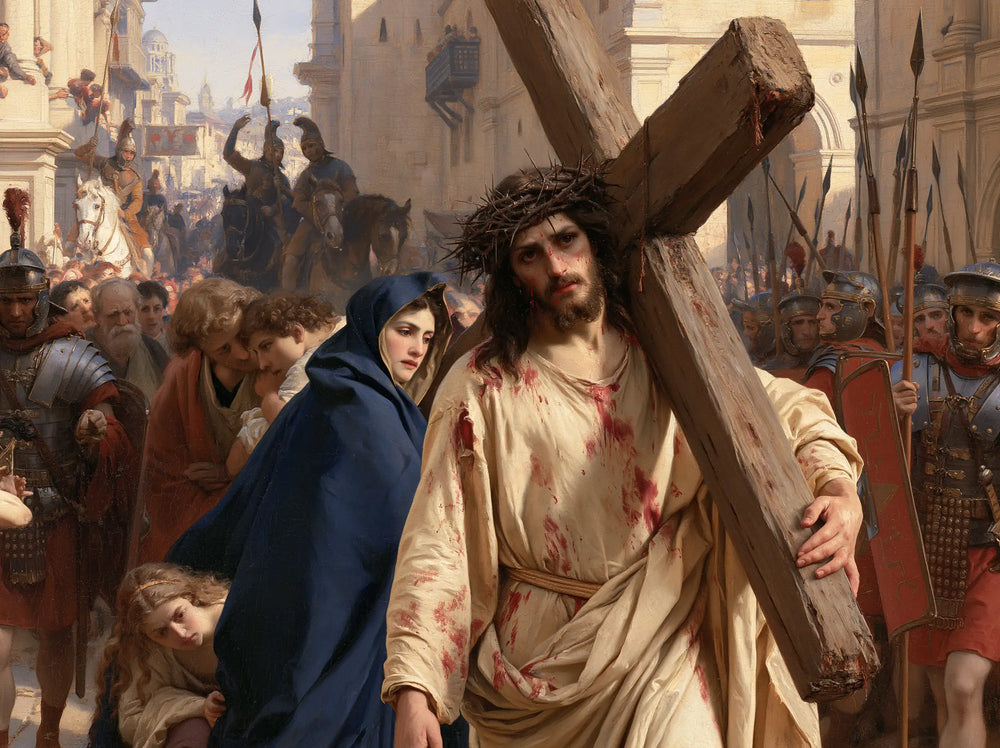
Here the route matters as much as the central figure. The city gives the journey a sense of duration. A larger print gives the background enough space to read while keeping Christ and the cross easy to locate.
5. The Cross through the Gathering Crowd

The surrounding figures give the journey a public character. Compare the crowd with the solitary ascent later in the guide. One places the viewer among witnesses while the other gives more room to the figure and the route ahead.
6. The Prayerful Gaze beneath the Timber

The eyes give the viewer a place to rest beneath the strong diagonal of the cross. This quieter interpretation suits a space where you can approach the print closely, such as beside a prayer chair or a reading desk.
7. The Road to Golgotha in Golden Light

Warm light makes the path and the distance part of the scene. Notice how your eye moves from the cross toward the route ahead. Pair this image with a frame that leaves the warmer tones of the artwork visible.
8. The Procession through the Narrow Street

The walls keep the procession close and give the group a strong direction. Read the foreground first, then follow the figures back into the street. A well-lit wall makes the secondary figures easier to see.
9. The Quiet Gaze beneath the Dark Beam

The beam supplies a dark, simple shape against which the gaze stands out. The restrained palette can anchor a quiet place. Choose diffuse light if you want to retain the detail in the shadowed passages.
10. The Solitary Ascent beneath the Cross

Removing much of the surrounding crowd allows the ascent and posture to tell the story. Compare it with the versions at the city gate and in the narrow street. This arrangement is suited to a viewer drawn to the subject as an image for prayer.
How to choose a print for prayer or display
For a quiet space, consider a close composition where the gaze of Christ carries the image. For a wider wall, a procession or a view of the approach to Golgotha lets the setting tell more of the story. Look at the darker versions under even lighting to retain the detail in the timber and clothing. Choose a size that suits the distance from which you normally see the wall.
Explore the companion guide
See 10 historic paintings of Christ carrying the cross →
Continue the Passion story with our guide to Crucifixion paintings.